When people first enter the world of specialty coffee, one of the most common questions is: does the shape of a dripper really change the taste of coffee?
The answer is yes—but perhaps not for the reason many people expect.
A dripper does not change the coffee itself. Instead, it changes how water flows through the coffee bed, influencing extraction and ultimately affecting how we perceive sweetness, acidity, body, and clarity.
Understanding this principle helps us make better brewing decisions—not by chasing the “best” dripper, but by choosing the right tool for the coffee and the experience we want to create.
The Role of Geometry
Although many variables influence extraction—including grind size, pouring technique, roast profile, filter paper, water composition, and coffee quality—the geometry of a dripper remains one of the most influential design elements.
Generally, drippers fall into two primary categories: flat bottom and conical. Each design guides water differently through the coffee bed.
Flat Bottom Drippers
Flat bottom brewers distribute water across a wider surface before it exits through multiple drainage points. This often encourages a more even extraction throughout the coffee bed.
In many brewing situations, this extraction pattern tends to produce:
- Higher perceived sweetness
- Fuller body
- Softer acidity
- Better overall balance
- A round and comforting finish
Rather than emphasizing one specific flavor note, flat bottom drippers often present the coffee as a cohesive and balanced cup.
Conical Drippers
Conical brewers naturally direct water toward the center of the coffee bed. This creates a different extraction dynamic that often highlights flavor separation and cup clarity.
Many brewers find that conical drippers tend to emphasize:
- Higher clarity
- Brighter acidity
- More transparent flavors
- Greater flavor separation
- Increased perception of complexity
This makes conical brewers especially enjoyable when the goal is to explore the unique characteristics of a coffee’s origin or processing method.
Our Brewing Observation
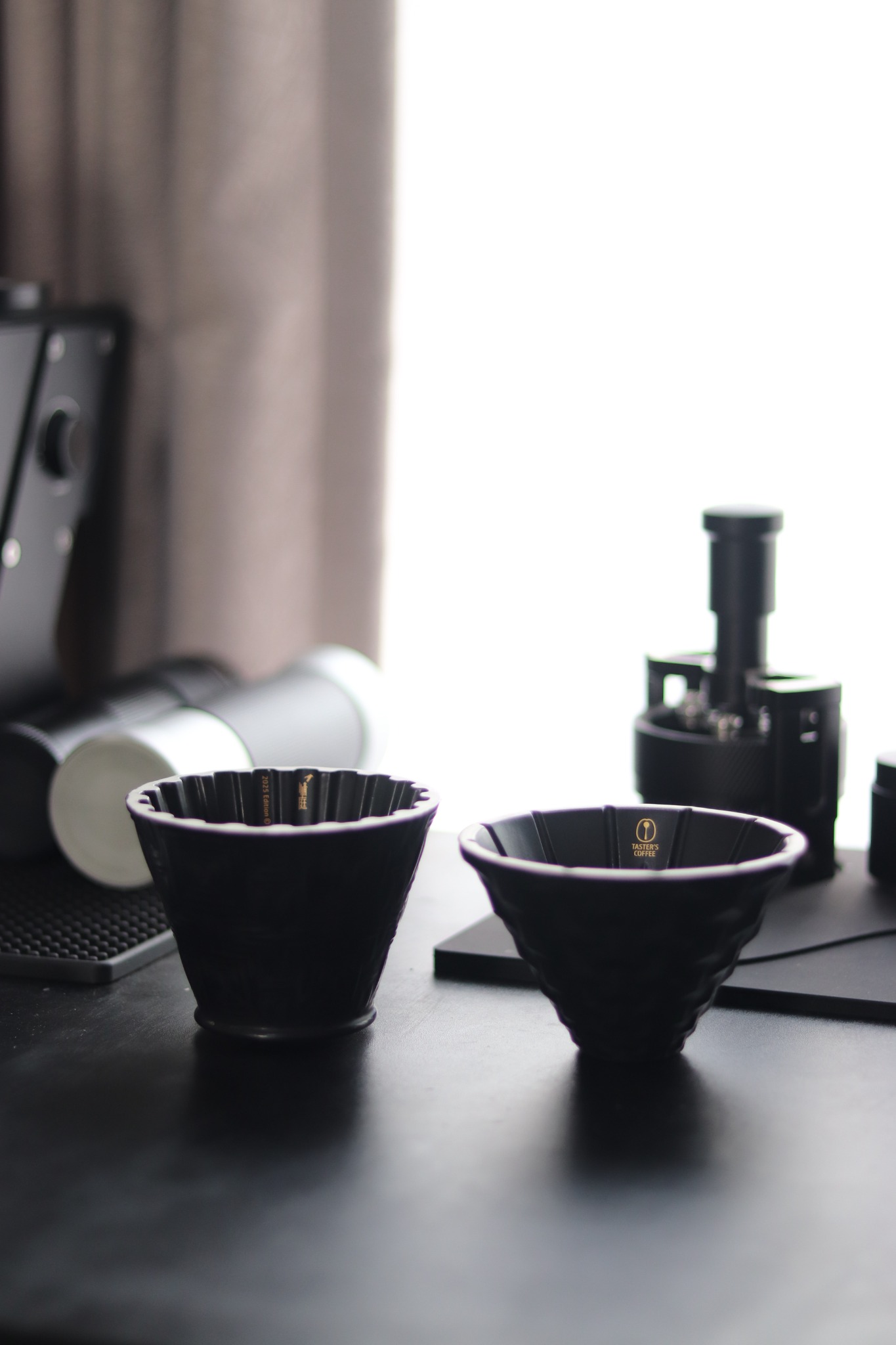
We used the same coffee, grinder, water, filter approach, and brewing recipe. The only variable changed was the dripper.
Tri Spin represented flat-bottom geometry, while CT62 represented conical geometry. Both brewers were produced by Dragon Fly Design.
Tri Spin
The coffee presented a sweeter profile, fuller body, and a more rounded finish. The cup felt balanced and forgiving, making it easy to enjoy.
CT62
The same coffee revealed greater clarity, brighter acidity, and more distinct flavor separation. Individual tasting notes became easier to identify.
These observations reflect our experience with this particular coffee and brewing setup. Different coffees, roast profiles, water chemistry, filter papers, and pouring techniques may produce different results.
There Is No Better Dripper
One of the biggest misconceptions in specialty coffee is believing that one dripper is objectively better than another.
In reality, each geometry simply reveals a different expression of the same coffee. A flat bottom brewer may highlight sweetness and body. A conical brewer may emphasize clarity and complexity. Neither is universally superior.
The better choice depends on the coffee you are brewing and the experience you hope to create.
Final Thoughts
Coffee brewing is not about finding a perfect dripper. It is about understanding how each variable influences extraction.
The more we understand these variables, the more intentional every cup becomes.
At SMC Roastery, we believe brewing is not only about following recipes. It is about understanding the science behind every decision we make.